There are six volumes of The Big O manga, all published and complete — no waiting for future releases, no indefinite hiatus. If you’ve been searching for the full rundown of The Big O manga volumes, this guide covers every book in the series, explains how the manga relates to the anime, and breaks down what you need to know about tracking down copies in English.
The series blends giant piloted robots with film noir storytelling — that moody, shadow-drenched detective fiction style — and layers on genuine existential dread. Six books, one self-contained story, and a whole lot of gothic mystery packed inside.
The Big O Manga — A Complete 6-Volume Gothic Noir Series
The Big O manga was created by Hitoshi Ariga (有賀ヒトシ), based on the original concept by Hajime Yatate (矢立肇). All six volumes were published in Japan by Kodansha under the Magazine Z KC label in 2003, and the English edition was released by VIZ Media — also six volumes, matching the Japanese release one-to-one. The series is completed.
The setting is Paradigm City, a place where everyone lost their memories forty years ago. Nobody knows why. The city rebuilt itself into a retro-futuristic metropolis — think towering geometric buildings, ornate facades, and permanent shadow — but the past keeps clawing its way back through buried technology, through nightmares, and through colossal piloted machines called Megadeus (giant robots of unknown origin) that no one can fully explain.
The protagonist, Roger Smith, is a negotiator — part private detective, part diplomat — who also happens to pilot the most powerful Megadeus in the city: Big O. When negotiations fail (and they usually do), the giant robot punches things. But the real tension isn’t in the robot battles. It’s in the unanswered questions. What happened forty years ago? Why were everyone’s memories erased? And is Paradigm City even what it appears to be?
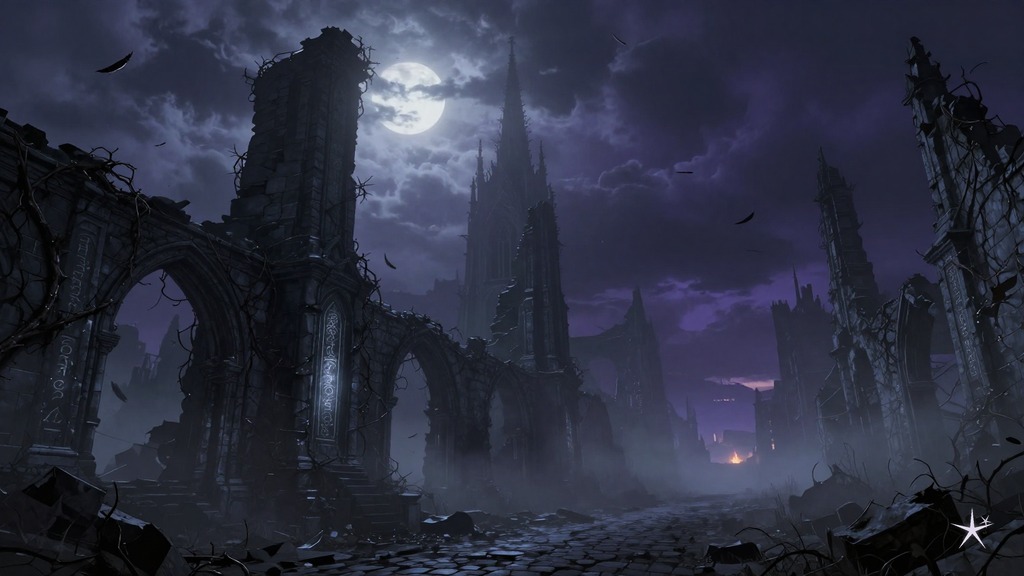
This is what makes The Big O fit squarely into dark fantasy territory despite its giant-robot elements. The gothic atmosphere — meaning dark, oppressive, haunted by decay and hidden dread — is thick throughout. Shadowed cityscapes, characters haunted by fragments of lives they can’t remember, a pervasive sense that reality itself might be constructed. The supernatural isn’t flashy here; it’s the creeping suspicion that nothing about this world is real.
How the Series Is Structured — Story Arcs Across 6 Volumes
Six volumes is a compact run, and Ariga uses the space efficiently. A story arc is a stretch of chapters that follows one connected plotline from setup to resolution, and this series blends self-contained cases — Roger negotiating with various clients and adversaries, each one a complete short story — with a slowly tightening overarching conspiracy about Paradigm City’s erased memories.
Early in the series, individual chapters often function like standalone noir episodes — moody detective stories where Roger takes a case, uncovers something unsettling, and resolves the immediate conflict. But each resolution leaves behind another piece of the larger puzzle. Who controls the memories? Who built the Megadeus machines? Why does the city feel like a stage set?
As the series progresses, those standalone threads start connecting. Rival Megadeus pilots appear. The power structures governing Paradigm City reveal darker layers. The line between Roger’s individual cases and the central mystery dissolves.
The manga also develops its own storylines that diverge from the anime’s plot. If you’ve watched the show, the manga won’t simply retread the same ground — Ariga takes the shared setting and characters in different directions, giving the six-volume run its own identity as a self-contained narrative.
A rough arc breakdown looks like this:
- Volumes 1–2: World-building and character establishment. Roger, Dorothy, and Big O are introduced. The noir-gothic atmosphere is locked in. The central mystery — erased memories — gets its hooks into the reader.
- Volumes 3–4: The conspiracy escalates. New antagonists enter. The manga’s divergence from the anime becomes more noticeable. Darker truths about Paradigm City’s power structures surface.
- Volumes 5–6: Climactic confrontations. The questions about memory, identity, and the nature of reality push toward some form of resolution — or, in keeping with the series’ tone, toward carefully chosen ambiguity.
Volume-by-Volume Breakdown
Volumes 1–2 — Welcome to Paradigm City
The first two volumes do the heavy lifting of establishing why Paradigm City feels so oppressive. Ariga’s artwork leans into deep blacks, dense linework layered in tight hatched patterns, and architectural designs that make the city feel simultaneously grand and claustrophobic. Every building looks like it’s hiding something.
Roger Smith is introduced as a man of contradictions — impeccably dressed, unfailingly polite, but willing to climb into an enormous machine of destruction when words fail. He lives by a personal code that feels almost anachronistic, like a tough-talking detective from a 1940s film who wandered into a science fiction nightmare.
Dorothy Wayneright enters early as well. She brings a dynamic to Roger’s world that cuts straight to the series’ core themes — her very existence raises questions about memory, identity, and what it means to be “real” in a city where no one can trust their own past. Without spoiling specifics, she is as central to the philosophical weight of the story as Roger himself.
The Big O Megadeus itself gets its first deployments here, and the battles serve double duty. Yes, they’re spectacle — giant robots smashing through buildings — but they also raise questions. Where did this machine come from? Why does Roger know how to pilot it? The robot action is inseparable from the mystery.
Early antagonists in these volumes aren’t simple villains. They’re people (and sometimes things) tangled up in Paradigm City’s buried history. Each confrontation peels back another layer of the city’s dark underpinnings, giving readers just enough information to stay hooked without answering the big questions.
Volumes 3–4 — The Conspiracy Deepens
The middle stretch is where The Big O shifts from atmospheric world-building into active conspiracy thriller territory. The self-contained case structure doesn’t disappear, but the cases themselves become more directly connected to the central mystery.
Rival Megadeus pilots show up, and their existence raises immediate questions. If Big O is unique, why are there other giant robots? Who’s supplying them? The power dynamics within Paradigm City — who actually runs things, and what they know about the lost memories — start coming into sharper focus.
These volumes also mark where the manga diverges more noticeably from the anime. Readers who came to the manga expecting a scene-by-scene retelling of the show will find Ariga charting his own course. Certain characters get different development. Plot threads go in unexpected directions. The shared foundation is obvious — same city, same core cast, same atmospheric identity — but the story being told is distinctly the manga’s own.
The dark fantasy elements intensify here. The supernatural undercurrent that was mostly atmospheric in the first two volumes becomes harder to ignore. Things happen in Paradigm City that can’t be explained by technology alone. The unease sharpens — not just “what happened to our memories?” but “what are we?”
Volumes 5–6 — Toward the Truth
The final two volumes bring the accumulated mysteries toward confrontation. Roger faces opponents who aren’t just threats to him physically but to his understanding of who he is and what Paradigm City actually represents.
Ariga handles the climactic stretch with a balance that suits the series’ tone. There are Megadeus battles — the final volumes deliver on the giant-robot action front. But the real climax is philosophical. The questions about memory, identity, and the nature of reality that have been building since volume one demand some kind of reckoning.
How much resolution you get depends on your tolerance for ambiguity. The Big O — in both its manga and anime forms — has never been a series that hands you a tidy explanation. Ariga brings the six-volume story to a definitive conclusion, but “conclusion” and “complete answer” aren’t the same thing. The gothic atmosphere persists right through the final pages. Some doors close; others are left deliberately ajar.
Volume 6 completes the series.
The Big O
For readers who appreciate dark fantasy that trusts them to sit with uncertainty, the ending works. It’s the kind of finale that rewards re-reading — details from early volumes take on new meaning once you’ve seen where Ariga takes the story.
Manga vs. Anime — Where the Story Diverges
Here’s a key detail that trips up a lot of newcomers: The Big O was conceived as a simultaneous media franchise, not as an anime that later spawned a manga. Sunrise (the Japanese animation studio behind the Gundam franchise, among others) commissioned both the anime and the manga together. Hitoshi Ariga’s manga began serialization in Kodansha’s Magazine Z in July 1999 — actually three months before the anime premiered in October 1999. Both were developed from the same franchise concept but tell distinct, original stories.
The franchise-level concept is credited to Hajime Yatate (矢立肇), the collective pen name used by Sunrise’s creative staff. Ariga developed the manga as its own work within that shared framework — it uses the same world, cast, and premise but tells an all-new story rather than retelling the anime. The collected volumes (tankōbon) were published in 2003, but the manga’s serialization predates the anime’s broadcast. The two share Paradigm City, the core cast, and the broad premise of erased memories and giant robots. Beyond that, they’re separate experiences.
What the manga emphasizes: Gothic noir atmosphere, tighter focus, more concentrated dark fantasy mood. Ariga’s artwork emphasizes shadow, mystery, and the oppressive weight of Paradigm City. The storytelling is more compact — six volumes versus the anime’s multi-season structure — which gives it a different pace and intensity.
What the anime emphasizes: More giant-robot action spectacle, a broader structure with more standalone stories, and a different approach to the overarching mystery. The anime had more runtime, which means more individual episodes that explore side characters and one-off scenarios before circling back to the central conspiracy.
Storyline divergences are real and significant. Characters develop differently. Plot threads branch in separate directions. The manga tells its own contained six-volume story that stands independent of where the anime goes.
Neither version makes the other redundant. If you’ve watched the anime and loved it, the manga offers a fresh take on the same world with its own distinct conclusions. If you’ve never seen the anime, the manga works perfectly well on its own — no prior viewing required.
For dark fantasy fans specifically, the manga is arguably the better entry point. The gothic noir atmosphere is Ariga’s strongest suit, and the concentrated six-volume format keeps the dread focused and unrelenting.
Which Edition Should You Buy
The English edition is straightforward: VIZ Media published all six volumes of The Big O manga, and the series is complete. You won’t be left hanging mid-story waiting for a volume that never comes.
Here’s what to know about actually getting your hands on copies:
- Format: Standard manga-size paperbacks. There are no known deluxe editions, omnibus editions, or hardcover reprints. What VIZ released in the 2000s is what’s available.
- Availability: These are older releases. Depending on when you’re looking, some volumes may be easy to find new and others may require checking secondhand markets — sites like eBay, AbeBooks, or Mercari, as well as used bookstores and manga trading communities on Reddit and other forums. Availability can fluctuate.
- Japanese edition: Published by Kodansha under the Magazine Z KC label, also six volumes. For readers who can read Japanese or who collect original editions, these exist as a separate option.
- Collecting difficulty: Six volumes is a very manageable complete set. Compared to dark fantasy series that run twenty, thirty, or forty-plus volumes, hunting down all six Big O books is a much smaller project. Even if some volumes take effort to find, you’re not facing a years-long collecting marathon.
If you’re specifically looking for Volume 6 to complete your set — or starting fresh and want to grab the final volume while it’s available — VIZ Media’s English edition is the one to look for.
When collecting older manga, condition matters. Check listings carefully for spine condition, yellowing, and whether the book was previously owned by a library (these copies often have stamps, stickers, or reinforced spines that affect condition). A complete set in good shape is worth the patience of waiting for the right copies.
Content and Tone — What to Expect
The Big O manga is not excessively violent or graphic by dark fantasy standards. The tone is closer to psychological suspense than horror — the dread comes from atmosphere and unanswered questions rather than gore or shock. Robot battles involve destruction on a city scale, but the series doesn’t dwell on graphic injury.
The heavier content is philosophical and psychological: characters confronting the possibility that their identities are fabricated, that their world may be artificial, and that the people controlling Paradigm City may have erased their humanity along with their memories. It’s unsettling in a cerebral way rather than a visceral one.
For younger readers or those sensitive to darker themes, the series is broadly comparable in intensity to other noir-influenced manga — shadowy, moody, and occasionally bleak, but not gratuitously dark. Most readers comfortable with dark fantasy in general will find this well within their range.
Frequently Asked Questions
How many volumes of The Big O manga are there?
Six volumes total. The Japanese edition (Kodansha) and the English edition (VIZ Media) both consist of six volumes. The series is complete — no additional volumes are planned or expected.
Is The Big O manga finished?
Yes. The series is completed. All six volumes have been published in both Japanese and English. You can read the entire story from beginning to end right now.
Who created The Big O manga?
Hitoshi Ariga (有賀ヒトシ) wrote and drew the manga, based on an original concept by Hajime Yatate (矢立肇). Hajime Yatate is actually a collective pen name — it’s the shared credit used by the creative staff at Sunrise, the Japanese animation studio that produced the Big O anime. So the underlying concept came from the anime production side, while Ariga developed the manga as its own work.
Is the manga the same as the anime?
No. They share the same setting (Paradigm City), core characters (Roger Smith, Dorothy Wayneright, and others), and basic premise (erased memories, giant robots, noir atmosphere). But the manga diverges with its own storylines, character development, and approach to the central mystery. Think of them as two different stories set in the same world rather than one being a copy of the other.
Is The Big O manga available in English?
Yes. VIZ Media published all six volumes in English. Since these are older releases from the 2000s, availability at any given retailer may vary. New and used copies can typically be found through online retailers and secondhand sellers on sites like eBay, AbeBooks, and Mercari.
Do I need to watch the anime first?
Not at all. The manga works as a standalone story. You don’t need any prior knowledge of the anime to follow the plot, understand the characters, or appreciate the gothic noir atmosphere. If you end up loving the manga, the anime is a great companion piece to explore afterward — but it’s not a prerequisite.
Is this more of a giant-robot series or a horror/mystery series?
It’s a mystery series that happens to feature giant robots. The Megadeus battles are visually dramatic and serve the plot, but the core of the story is the noir detective framework and the slow-burning conspiracy about Paradigm City’s erased past. If you’re coming for the robots, you’ll get them — but if you’re coming for the atmosphere and the questions that linger after you close the book, that’s where The Big O really lives.