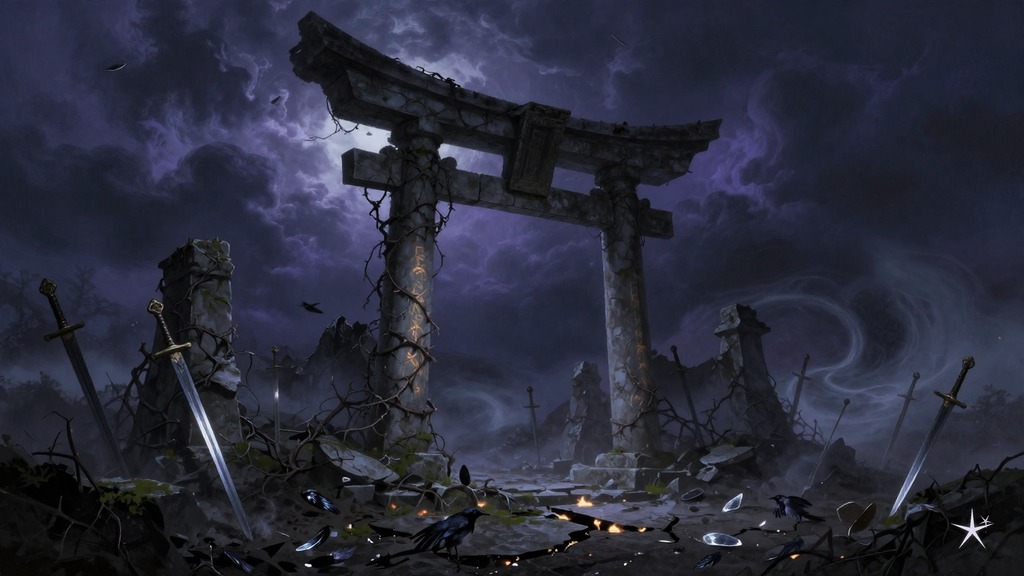
Inuyasha (犬夜叉 — the Japanese title you’ll see on original editions) is one of those series that keeps pulling new readers in, years after its final chapter. Created entirely by Rumiko Takahashi — story and art — this sprawling feudal-era dark fantasy was published chapter by chapter in Weekly Shonen Sunday, a manga anthology magazine from publisher Shogakukan. In manga, this chapter-by-chapter magazine release is called serialization, and those chapters are later collected into bound books called volumes. The original Japanese edition runs 56 volumes. The final volume hit shelves in Japan on February 18, 2009.
For anyone searching for the complete Inuyasha manga volumes in English, VIZ Media publishes the entire series in an 18-volume VIZBIG omnibus format — an omnibus being an oversized book that bundles multiple standard volumes into one. These are available in both print and digital. That’s the entire 56-volume story collected into 18 oversized books.
Whether you’re coming from the anime, picking it up for the first time, or trying to figure out which edition to grab, here’s everything laid out clearly.
Inuyasha Manga Volumes — The Complete Dark Fantasy Run at a Glance
The quick version: Inuyasha is a completed series. No waiting for new volumes, no publishing pauses, no ambiguous ending. The Japanese Shonen Sunday Comics edition — the standard collected-volume format in Japan — runs 56 volumes. The English VIZBIG omnibus edition from VIZ Media covers the identical story across 18 volumes. Both are available in print and digital.
Takahashi wrote and drew every chapter herself — no separate writer and artist, no studio team. The VIZ VIZBIG edition carries a T+ rating, a content advisory from VIZ Media meaning it’s recommended for older teens and up (comparable to a PG-13 movie rating, roughly). That rating exists for good reason. Beneath the romance and comedy beats, Inuyasha is a series built on demonic curses, body-horror transformations, and the existential nightmare of being half-demon in a world where both humans and demons reject you.
The dark fantasy core is woven into the premise itself. Inuyasha isn’t a hero who fights monsters from a position of safety — he is the monster, barely held in check. The Shikon Jewel doesn’t grant wishes cleanly; it corrupts them. The villains aren’t distant threats; they’re born from human obsession twisted into literal flesh. If you’ve been looking for a long-running fantasy manga with genuine supernatural horror running underneath its adventure surface — something with the dark atmosphere of series like Claymore or D.Gray-man but threaded with more warmth and humor — this is a strong pick.
How the Story Arcs Break Down by Volume
Navigating 56 volumes can feel overwhelming, so here’s how the major narrative arcs — each arc being a self-contained story segment within the larger series — break across the run. Volume numbers below refer to the Japanese Shonen Sunday Comics numbering (1–56). If you’re reading the VIZBIG omnibus, each omnibus volume collects roughly three Japanese volumes’ worth of story, so you can estimate your position by dividing the Japanese volume number by three.
The Shikon Jewel Shattered — Early Volumes
The story opens with modern-day middle schooler Kagome Higurashi falling through a well into Japan’s Sengoku period — an era of civil war and feudal conflict roughly spanning the late 1400s to early 1600s — where she encounters a pinned, sleeping half-demon: Inuyasha. She accidentally shatters the Shikon Jewel — a powerful supernatural artifact — into hundreds of fragments scattered across the land, and the quest to recover them becomes the engine of the entire series.
These early volumes establish the core dark fantasy tension that defines Inuyasha as a character. He’s not just a fighter with dog ears. His demonic blood is an active threat — when pushed past his limits, he transforms into a mindless berserker, losing himself entirely. The horror isn’t the demons he fights. It’s the demon he already is.
Takahashi uses these opening volumes to lay the groundwork efficiently. The shard-hunting premise gives the story episodic structure while building toward something much larger, and each encounter with yokai — the supernatural creatures of Japanese folklore, ranging from shape-shifting foxes to massive predatory demons — introduces the rules of a world where these beings treat humans as prey and entire villages can be wiped out between chapters.
Gathering Allies and Rising Threats — Early-to-Mid Volumes
The cast expands as Inuyasha and Kagome are joined by three companions, each carrying their own dark burden:
- Miroku, a monk cursed with the Wind Tunnel, a named ability unique to this series — a void in his right hand that will eventually consume him alive, a generational curse passed down from his grandfather. Every time he uses his most powerful ability, he’s accelerating his own death.
- Sango, a demon slayer whose entire village was massacred and whose younger brother Kohaku was manipulated into participating in the killing under demonic mind control.
- Shippo, a young fox demon orphaned by thunder demons.
The party dynamic gives Takahashi room to balance lighter character moments against escalating yokai violence. But Miroku’s curse is the standout dark fantasy element here — it’s not a battle wound or a tragic backstory that stays in the past. It’s a ticking clock embedded in his body. The Wind Tunnel grows wider over time. He will die from it unless the source of the curse is destroyed. That source, as the story reveals, is the series’ central villain.
Naraku’s Machinations — Mid Volumes
Naraku emerges as the true antagonist, and he’s one of the more unsettling villains in long-running manga. Originally a human bandit consumed by obsession, he offered his body to a swarm of demons and became something new — a shape-shifting amalgamation of absorbed demonic flesh that continuously evolves.
The body-horror elements ramp up significantly in these volumes. Naraku doesn’t just command minions; he births them. His incarnations — beings like Kagura, Kanna, and others that are literally detached pieces of his own body given independent form — exist at his pleasure and can be reabsorbed at any time. Kagura’s arc is particularly grim: she’s a wind sorceress who desperately wants freedom, but Naraku holds her heart — physically, literally, outside her body.
The Band of Seven storyline introduces a squad of undead mercenaries resurrected through Shikon Jewel shards. These aren’t noble warriors brought back to fight — they’re killers who enjoyed their work in life and enjoy it even more now that death can’t stop them. This stretch leans hard into the series’ darker impulses and stands out as one of the most action-heavy segments of the manga.
The Deepening War Against Naraku — Mid-to-Late Volumes
The back half of the series is defined by escalation. Naraku grows stronger through absorption — consuming other demons, manipulating allies into betrayal, evolving his body into increasingly grotesque forms. The stakes shift from “collect the jewel shards” to “stop an entity that may become unkillable.”
Sesshomaru’s storyline deepens across these volumes and provides one of the series’ most compelling character transformations. Inuyasha’s full-blooded demon half-brother begins the story as a cold, contemptuous figure who views humans as beneath notice. Slowly — through his reluctant protection of a human child named Rin — he develops something he’d never admit to: compassion. His journey from killer to protector mirrors the series’ larger question about what separates demons from humans.
Meanwhile, Inuyasha’s struggle with his own demon blood reaches critical tension. Multiple transformation episodes push him closer to the edge — moments where he loses all humanity and becomes a killing machine. The recurring question isn’t whether he can defeat Naraku. It’s whether he can do it without becoming something worse.
The Final Battle and Resolution — Final Volumes
The endgame reveals the Shikon Jewel itself as something far more sinister than a simple power source. The jewel is a sentient, malevolent entity — it doesn’t just amplify desire; it feeds on conflict. Every wish made upon it perpetuates a cycle of suffering. The “artifact quest” that drove the entire series turns out to be the trap.
Naraku’s ultimate form pushes the body horror to its peak, and the final confrontation forces every member of the party to confront their curses, losses, and fears simultaneously. The resolution addresses Miroku’s Wind Tunnel, Sango’s grief, Sesshomaru’s transformation, and the central question that haunts the entire series: can Kagome and Inuyasha exist in the same world?
The ending is bittersweet in the best sense — satisfying without being neat, emotional without being cheap. Takahashi earned it across 56 volumes, and the final chapters land with weight.
Inuyasha (VIZBIG Edition), Vol. 18
VIZBIG Vol. 18, the final book of the English omnibus edition, collects the series’ closing chapters through Volume 56. If you’ve been collecting the VIZBIG set, this is where everything pays off — the Shikon Jewel’s fate, the final showdown with Naraku, and the answer to whether Kagome stays in the feudal era. It’s a satisfying capstone to a very long journey.
What Makes Inuyasha a Dark Fantasy
VIZ Media classifies Inuyasha as action-adventure and fantasy, which is technically accurate but undersells how dark the series actually gets. Here’s what puts it firmly in dark fantasy territory:
Demonic body horror is constant. Naraku’s incarnations are born from his flesh. Yokai designs range from grotesque to nightmare-fuel. Inuyasha’s berserker demon form — claws extended, eyes red, rational mind gone — is presented not as a power-up but as a loss of self. The series treats transformation as violation, not empowerment.
Cursed existence is the central theme. Nearly every major character is defined by a curse they didn’t choose:
- Inuyasha is half-demon, rejected by both humans and demons, losing control of his body when his demon blood surges
- Miroku inherited a void in his hand that will kill him
- Kikyo was resurrected as an undead priestess sustained by stolen souls — alive enough to feel, dead enough that her existence is an abomination
- Sango’s brother Kohaku is kept alive by a jewel shard, his memories of massacring his own family suppressed but not erased
The setting is hostile. Sengoku-period Japan in Inuyasha isn’t a charming historical backdrop. Villages are destroyed regularly. Humans are prey. Demons aren’t rare encounters — they’re an ecosystem of predators that the human population endures rather than controls.
The Shikon Jewel is a corrupting artifact. It doesn’t grant power cleanly. It twists desire into destruction, and the series’ final revelation — that the jewel is itself a conscious, malicious entity — reframes the entire 56-volume quest as a story about being manipulated by the thing you’re trying to control.
What makes Inuyasha special as a dark fantasy is tonal balance. Takahashi never abandons humor or romance — the comedic beats between Inuyasha and Kagome are genuine and warm. But the grim supernatural stakes are always there underneath, and they get grimmer as the series progresses. For readers who want dark fantasy that doesn’t drown in misery, Inuyasha is a strong entry point into the genre.
Manga vs. Anime — Where the Adaptation Diverges
Inuyasha has been adapted into anime — meaning the story was retold in animated form — twice, and understanding the split matters if you’re deciding whether to read, watch, or both.
The first anime series ran for 167 episodes (airing from October 2000 to September 2004). It covered a significant portion of the manga but ended before the manga’s own conclusion — the manga continued serializing until 2008. This means the first anime effectively stops mid-story.
Inuyasha: The Final Act picked up where the first series left off and ran for 26 episodes, adapting the remaining story through to the manga’s ending. It’s a much more compressed adaptation — covering a large chunk of the manga’s back half in far fewer episodes.
Four theatrical films also exist, but these are standalone side stories set in the same world — they don’t continue the main plot and aren’t based on manga chapters. They won’t fill in any gaps if you’re following the core narrative.
If you watched the first anime and want to continue in manga form, the first series roughly corresponds to the first 36 volumes of the manga’s 56-volume run. The Final Act then covers the remaining volumes through to the end.
For dark fantasy fans specifically, the manga is the stronger experience. The pacing gives significantly more room to Naraku’s body-horror escalation, the grimmer yokai encounters, and the slower burn of character curses reaching their breaking points. The anime (particularly the first series) smooths some of the darker edges for broadcast, while the manga lets Takahashi’s art — detailed, occasionally visceral — carry the full impact.
The recommendation: Read the manga for the complete dark fantasy experience. If you want to supplement with anime, The Final Act is a solid companion piece for the endgame.
Which Inuyasha Manga Volumes Should You Buy
English readers have one primary option, and it’s a good one: the VIZBIG omnibus edition from VIZ Media.
Here’s what you need to know:
- 18 volumes covering the complete 56-volume Japanese run
- Available in print and digital
- Rated T+ (older teen) by VIZ Media
- Each VIZBIG volume collects roughly three Japanese volumes’ worth of content
- The oversized format gives Takahashi’s detailed art more room to breathe on the page
The VIZBIG format is well-suited to a series this long. Rather than tracking down and shelving 56 individual books, you get the entire story in 18 oversized volumes. For reading a long dark fantasy epic straight through, it’s the practical choice.
The Japanese edition (Shonen Sunday Comics) is also available in 56 volumes, both paper and digital, for readers who prefer the original language.
For new readers starting fresh, the VIZBIG omnibus is the way to go. It’s the most widely available English format, it’s complete, and the larger page size does Takahashi’s art justice — particularly the detailed yokai designs and action sequences that define the series’ dark fantasy identity.
Frequently Asked Questions
How many volumes of Inuyasha are there?
The Japanese Shonen Sunday Comics edition has 56 volumes. The English VIZ VIZBIG omnibus edition has 18 volumes covering the same complete story. No content is cut — the VIZBIG editions collect the full manga.
Is the Inuyasha manga finished?
Yes. Inuyasha is a completed series. Serialization ended on June 18, 2008, and the final Japanese volume was released on February 18, 2009. You can read from start to finish without waiting for anything.
Who created Inuyasha?
Rumiko Takahashi is the sole creator — she wrote the story and drew the art herself. She’s one of the most prolific manga creators in the medium’s history, with a career spanning decades and multiple long-running series.
What is the VIZBIG edition?
An omnibus format published by VIZ Media that collects the full 56-volume Japanese run into 18 English-language books. Each VIZBIG volume contains roughly three original volumes’ worth of chapters — chapters being the individual installments that were originally published week by week in a magazine before being collected into these books. They’re available in both print and digital and carry a T+ (older teen) content rating.
Is Inuyasha really a dark fantasy?
While VIZ classifies it as action-adventure and fantasy, the series is steeped in demonic horror, cursed protagonists, supernatural body horror, and a feudal world terrorized by yokai. Inuyasha’s demon transformations are framed as loss of control, not power-ups. Miroku carries a curse that will kill him. Kikyo is an undead priestess sustained by stolen souls. Naraku births minions from his own flesh. The T+ rating exists for a reason.
The tonal balance — humor and romance threaded through genuinely grim stakes — is part of what makes Inuyasha work. It’s not unrelenting darkness, but the dark fantasy elements are structural, not decorative.