Children of the Sea Manga Reading Order at a Glance
Good news: the Children of the Sea manga reading order is simple. Children of the Sea (海獣の子供) is a completed manga by Daisuke Igarashi (五十嵐大介), published in English by VIZ Media. The entire story runs 43 chapters across 5 volumes — each volume being a collected paperback containing multiple chapters — and you read them in order, Volume 1 through Volume 5. That’s it. No spin-offs, no side stories, no alternate timelines, no “where do I start?” headaches.
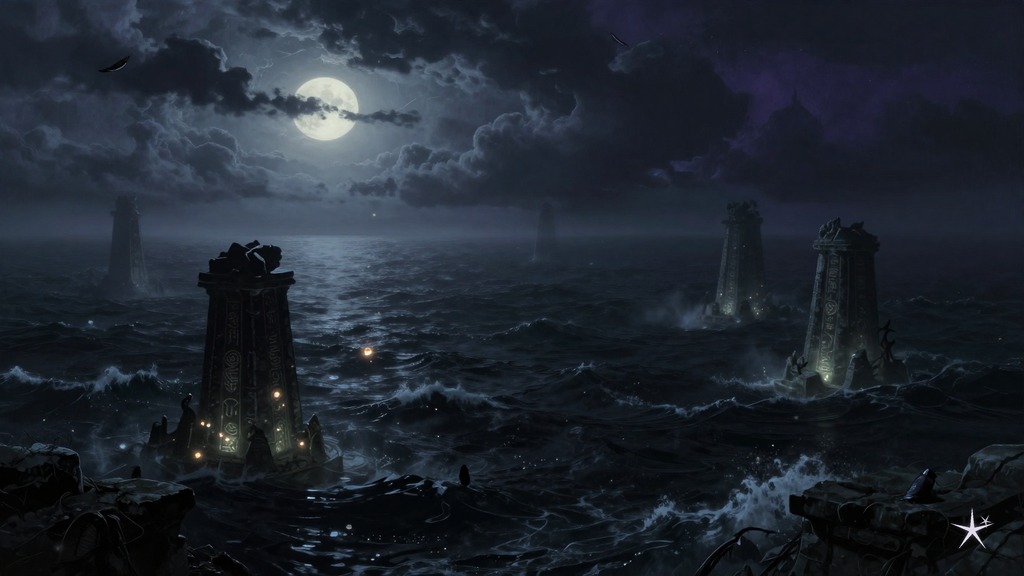
So why does this manga series show up on a site about dark fantasy? Because beneath its coming-of-age surface — a story about growing up — Children of the Sea is one of the most genuinely unsettling manga you’ll encounter. Igarashi draws the ocean as something vast, ancient, and indifferent to human understanding. The art is hyper-detailed, almost obsessively rendered, and the story drifts from a girl’s summer by the sea into territory that feels like cosmic horror — the creeping realization that the universe is far stranger and larger than humans can comprehend. If you like your dark fantasy philosophical and surreal rather than swords-and-sorcery, this series is a quiet masterpiece worth your time.
The manga was originally published chapter by chapter in Monthly IKKI (月刊IKKI), a Japanese manga magazine, from December 2005 to September 2011 (the collected tankōbon volumes were published from August 2007 to August 2012). The Japanese collected edition was published under the Ikki Comix label. The series has been well-received by fans and critics alike, earning recognition for both its art and its storytelling ambition.
Here’s the full reading order at a glance:
| Order | Title | Chapters | Publisher (English) |
|---|---|---|---|
| 1 | Children of the Sea, Vol. 1 | Ch. 1–9 | VIZ Media |
| 2 | Children of the Sea, Vol. 2 | Ch. 10–18 | VIZ Media |
| 3 | Children of the Sea, Vol. 3 | Ch. 19–27 | VIZ Media |
| 4 | Children of the Sea, Vol. 4 | Ch. 28–36 | VIZ Media |
| 5 | Children of the Sea, Vol. 5 | Ch. 37–43 | VIZ Media |
Straightforward. Let’s break down what you need to know about editions before you pick up Volume 1.
What Edition Should You Read?
VIZ Media English Singles — The Standard Choice
The VIZ Media English singles are the standard and most widely available edition. Five volumes, each collecting roughly 8–9 chapters, with Igarashi’s artwork reproduced at the original page dimensions. These are the books you’ll find at major retailers, and they’re the definitive way to read the series in English.
Children of the Sea, Vol. 1 is where every reader should begin — and where you’ll immediately understand why Igarashi’s art has such a dedicated following.
There is no confirmed omnibus (a single book combining multiple volumes into one), deluxe, or hardcover English edition of Children of the Sea. Some series get the big collected treatment years after completion, but as of now, the five individual volumes are what’s available. This isn’t a drawback — at only five books, the series is already compact to collect. At typical retail prices, you’re looking at a modest investment for the complete set.
Digital Availability
Digital editions are available through platforms like the VIZ Manga app, Kindle, and other common manga storefronts. If you prefer reading on a tablet or phone, digital can be a great option for this series specifically because you can zoom into Igarashi’s incredibly detailed panels — and you’ll want to.
Japanese Ikki Comix Edition
For collectors and Japanese readers, the original Ikki Comix edition (5 volumes) is the source material. These aren’t necessary for English readers, but they’re worth knowing about if you ever want to compare the original formatting or pick up a set for your shelf.
The short version: grab the VIZ Media English singles. They’re the right choice for virtually everyone reading this guide.
Complete Reading Order — Volume by Volume
Since Children of the Sea is a single, continuous story with no branching paths, the reading order is strictly linear. But each volume has a distinct character, so here’s a spoiler-light breakdown of what to expect as you move through the series.
Volume 1 — The Pull of the Ocean (Chapters 1–9)
The story opens with Ruka, a junior high student whose summer is going badly. Kicked off her handball team and restless at home, she ends up at the aquarium where her father works — and meets two mysterious boys, Umi and Sora. They were raised by dugongs — large, gentle marine mammals related to manatees — in the ocean, and something about them isn’t quite normal. Volume 1 establishes the coastal setting, Ruka’s loneliness, and the first hints that the ocean is hiding something enormous. Igarashi’s art here is already remarkable — his sea life illustrations feel like nature documentary frames rendered in ink.
Volume 2 — The Vanishing (Chapters 10–18)
Things get stranger. Sea creatures around the world begin vanishing, and scientists are baffled. The connection between Umi, Sora, and these events starts to crystallize, but answers stay just out of reach. The cosmic scope of the story widens dramatically — this isn’t just about a girl and two boys anymore. It’s about the ocean itself, and what it might be preparing for. Volume 2 is where readers who came expecting a simple summer story realize they’re in much deeper water.
Volume 3 — Transformation (Chapters 19–27)
The story’s dark undercurrents break the surface. Body transformation becomes a recurring motif — characters change physically in ways that are beautiful and deeply unsettling at the same time. Existential questions pile up: What is the relationship between humans and the sea? What are Umi and Sora, really? Igarashi’s page layouts — the way panels are arranged and sized on each page — become more experimental here, with pages that feel less like sequential art and more like illustrated meditation. This is the volume where the series fully commits to its surreal identity.
Volume 4 — The Gathering (Chapters 28–36)
The narrative accelerates hard. Events converge toward something enormous — a cosmic event tied to the ocean that Igarashi has been building toward since page one. The atmosphere shifts from mysterious to almost overwhelming, with imagery that borders on abstract. If Volumes 1–3 were the tide coming in, Volume 4 is the moment before the wave breaks. This is cosmic horror in its purest form: not monsters jumping out at you, but the dawning realization that you are impossibly small in the face of something that doesn’t care whether you understand it.
Volume 5 — Resolution (or Dissolution) (Chapters 37–43)
The final volume delivers the story’s climax — though “delivers” might be the wrong word, because Igarashi’s ending is more experiential than narrative. The ocean’s grand mystery reaches a resolution that some readers will find transcendent and others will find deliberately elusive. Without spoiling anything: if you’ve trusted the series this far, Volume 5 rewards that trust. It’s a conclusion that fits the story’s DNA perfectly.
Children of the Sea, Vol. 5 is the final volume and the culmination of everything Igarashi built across the series.
Children of the Sea, Vol. 5 (final volume)
A note on reading order: there is absolutely no reason to read these out of sequence. No prequels, no alternate viewing orders, no fan-recommended alternate paths. Volume 1 through Volume 5. Done.
The Anime Film — Where It Fits
Studio 4°C released a feature-length anime film adaptation of Children of the Sea in 2019, directed by Ayumu Watanabe. There’s a decent chance the film is how you heard about the series in the first place. It compresses all five volumes into a single viewing experience, and while it’s visually stunning — the animation of ocean life is genuinely breathtaking — it necessarily leaves out layers of detail that Igarashi packed into his manga pages.
The recommendation: read the manga first. Here’s why:
- Pacing matters. Igarashi’s story builds slowly and deliberately. The manga gives you time to sit with each revelation, each transformation, each increasingly strange event. The film, by necessity, moves faster and cuts subplots.
- The art rewards close reading. Igarashi’s panels are dense with visual information — sea creatures rendered in meticulous biological detail, page layouts that shift and flow like water. You can’t pause and stare at a movie screen the way you can linger over a manga page.
- The abstract ending lands differently. The story’s climax is surreal and open to interpretation. In manga form, you can flip back, reread, and piece things together. In film form, it washes over you once and moves on.
That said, the anime film makes a wonderful companion piece after you’ve finished the manga. Seeing Igarashi’s ocean brought to life in motion is a genuinely special experience. Think of it as dessert, not the main course.
Tips Before You Start Reading
Take Your Time with the Art
This is not a manga you speed-read. Igarashi’s page layouts are dense and unconventional — sometimes a single page will contain more visual information than an entire chapter of a fast-paced action manga. Let your eyes wander. Look at the backgrounds. Study the sea creatures. The art isn’t just decoration; it is the storytelling.
The Shift Is Intentional
Children of the Sea starts grounded. A girl, a summer, an aquarium. By the end, you’re in territory that feels dreamlike and abstract — images and feelings taking over where traditional plot leaves off. This transition from an everyday, grounded story into surreal cosmic territory is entirely intentional. If you hit a point where you think “wait, what’s happening?” — keep going. Igarashi is not confused; he’s taking you somewhere specific. The destination just happens to be beyond words.
Who This Series Is For
Children of the Sea is best suited for readers who enjoy:
- Philosophical dark fantasy — stories that ask big questions and don’t hand you easy answers
- Surreal, atmospheric storytelling — mood and imagery over plot mechanics
- Nature-focused horror — the ocean as something ancient and unknowable, not a backdrop for adventure
- Thoughtful, art-driven manga — works where the visual storytelling carries as much weight as the writing, and the pace is slow and intentional
If you’re looking for fight scenes, power systems, or clear-cut heroes and villains, this isn’t your series. But if you’re curious about manga that makes you feel something strange and hard to name — something that might make you stare at the ocean differently the next time you see it — this is exactly right, even if you’re brand new to the medium.
Content Note
Children of the Sea doesn’t deal in graphic violence or explicit content. Its darkness is atmospheric — themes of loss, transformation, and the terrifying vastness of nature. It can be deeply unsettling without ever showing a drop of blood. Think of it as emotional unease rather than physical horror. The discomfort comes from the feeling that the world is far larger and stranger than anyone can fully grasp. Some readers find this more affecting than any gore-heavy series, precisely because the source of the unease is harder to pin down.
Start Here — The Recommended Order and Edition
Let’s wrap this up cleanly.
Reading order: Volume 1 → Volume 2 → Volume 3 → Volume 4 → Volume 5. No exceptions, no shortcuts.
Edition: The VIZ Media English singles. Five volumes, 43 chapters, one complete story. No omnibus or deluxe edition to wait for — what’s available now is the definitive English version. You can find them at major retailers and through digital manga platforms.
After the manga: Watch the 2019 anime film for a beautiful visual companion to the story you just read.
Total commitment: Five volumes. That’s it. Children of the Sea is one of the most accessible entry points into dark, surreal manga — not because it’s easy to understand, but because the investment is small and the payoff is enormous. You can finish the whole series in a long afternoon or a relaxed weekend, though the denser volumes may have you lingering over individual pages.
Daisuke Igarashi created something genuinely unique with this series. The ocean has never been drawn like this before or since, and the story he tells through it — about a girl, two impossible boys, and the vast intelligence hiding beneath the waves — is unlike anything else in manga. Five volumes. Give it a chance.