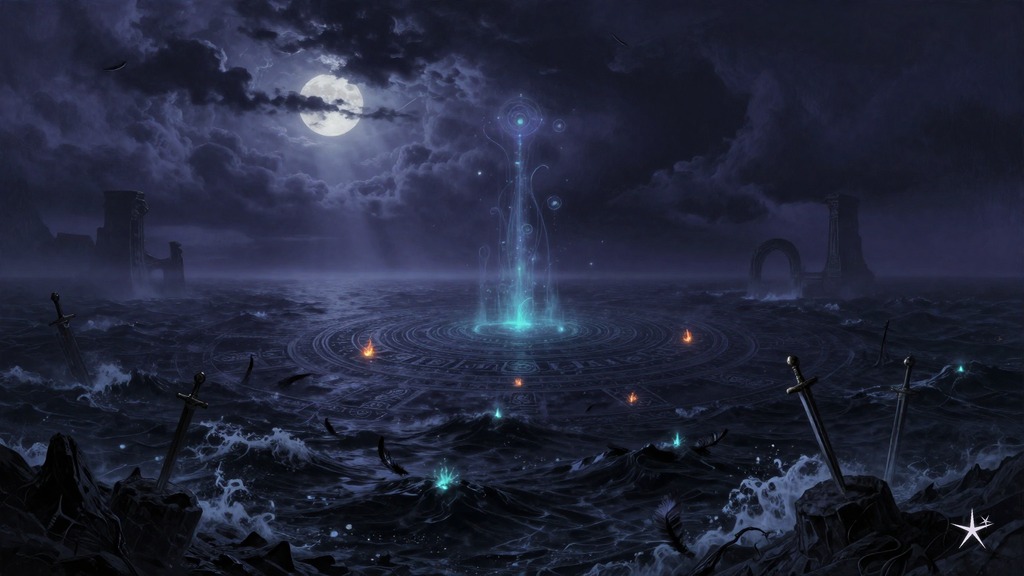
If you’ve been eyeing Children of the Sea (海獣の子供 — the original Japanese title) and wondering whether the Children of the Sea manga is finished or still ongoing — good news. This one is done. Fully, completely done, with a definitive ending. Here’s the full rundown on the series’ status, what to expect from its conclusion, and how to read the whole thing from start to finish.
Children of the Sea Manga Is Finished — All 5 Volumes Completed in 2012
Yes, Children of the Sea by Daisuke Igarashi (五十嵐大介) is a completed manga. The series originally ran chapter by chapter in Monthly IKKI, a manga magazine published by Shogakukan in Japan. (In Japan, manga stories typically debut as individual chapters in magazines before being collected into book-format volumes — similar to how a novel might first appear as a serial in a literary journal.) The serialization ran from 2005 to 2011, spanning 43 chapters collected into 5 volumes, with the final collected volume released in 2012.
Shogakukan is one of Japan’s largest publishers, and all 5 volumes have been released in English by VIZ Media, a major English-language manga publisher. There is no ongoing chapter run, no indefinite pause in publication, and no continuation. The story Igarashi set out to tell is fully told within those five books.
For readers who like knowing the finish line before they start — this is one of those rare manga where you can pick up volume 1 with complete confidence that the ending exists, is intentional, and wraps the narrative on the author’s own terms. Five volumes. Forty-three chapters. Beginning, middle, end. That’s it.
How Children of the Sea Ends — A Cosmic Dark Fantasy Conclusion
Without spoiling specifics, here’s what you should know about where this story goes.
Children of the Sea builds steadily toward an otherworldly oceanic event — a kind of cosmic ritual that ties together all the supernatural mysteries the series has been weaving since the first chapter. If you’ve been following the strange marine phenomena, the disappearing sea creatures, and the enigmatic boys Umi and Sora, the final volume pulls all of those threads into a single, overwhelming climax.
What Kind of Ending to Expect
This is not a manga that hands you tidy answers. The ending is deliberately ambiguous and poetic, which is very much in line with Daisuke Igarashi’s storytelling approach. He’s an artist who trusts images over dialogue-heavy explanation, and the finale leans heavily into visual metaphor, mythic imagery, and a sense of awe that borders on the abstract.
If you’re coming in expecting a conventional plot resolution — villain defeated, mysteries explained, everyone’s fate neatly accounted for — you’ll want to recalibrate. This is closer to the feeling of watching a nature documentary about deep-ocean glowing sea life and realizing how small and strange the world actually is.
That said, the story does reach a genuine emotional resolution. Ruka’s journey has a clear arc, and the final pages carry real weight. The ambiguity is in the cosmic details — the “what exactly just happened on a metaphysical level” questions — not in whether the story reached its destination. It absolutely does.
Why Dark Fantasy Readers Connect With It
The cosmic, unknowable quality of the ending is exactly what makes it land for dark fantasy readers. There’s a tradition in the genre — visible in series like Blame! by Tsutomu Nihei, where vast, incomprehensible environments dwarf the human characters — where the “answer” isn’t a plot point but a feeling. Children of the Sea sits in that tradition. The ocean becomes something alien, ancient, and fundamentally beyond human comprehension, and the ending embraces that instead of trying to explain it away.
Panels that seemed purely atmospheric on first pass reveal layered meaning once you know where everything is heading.
The Complete Collection — All 5 Volumes at a Glance
Here’s a volume-by-volume overview of what you’re getting into. All five volumes were originally published by Shogakukan in Japan and released in English by VIZ Media.
Volume 1 (2007)
The story opens with Ruka, a young girl spending her summer break at the aquarium where her father works. She encounters two mysterious boys — Umi and Sora — who were reportedly raised by dugongs (large marine mammals related to manatees) in the open ocean. Strange things are happening at the aquarium and in the sea beyond it. Volume 1 establishes the grounded, human side of the story (Ruka’s family tensions, her restlessness) alongside the first hints that something vast and supernatural is stirring beneath the waves. Igarashi’s artwork immediately sets the tone — detailed, organic, and teeming with marine life rendered in almost scientific precision.
Volume 2 (2007)
The supernatural ocean phenomena deepen. Ruka is drawn further into the world that Umi and Sora inhabit, and her connection to the sea — something she can’t quite explain rationally — becomes impossible to ignore. The scope of the mystery widens beyond the local aquarium to suggest something global in scale. This volume is where readers typically realize the story is going somewhere much stranger and more ambitious than a summer story about a girl growing up.
Volume 3 (2008)
Marine life is vanishing worldwide. Scientists are baffled. The cosmic mystery at the heart of the series escalates dramatically, and the story begins pulling in mythological and metaphysical threads from various ocean-adjacent cultures. Igarashi’s art grows increasingly surreal and ambitious — full-page and two-page illustrations (where a single image stretches across both open pages) that blur the line between sequential storytelling and fine art. The pacing shifts here too, becoming more meditative and dreamlike.
Volume 4 (2009)
Everything builds toward what the series calls the festival of the sea — the central supernatural event that Umi, Sora, and Ruka have been orbiting since the beginning. Volume 4 is the slow inhalation before the plunge. Characters converge, the scope becomes fully cosmic, and the art reaches a level of density and detail that’s almost overwhelming on the page. This is the volume where readers either fully surrender to Igarashi’s vision or realize this particular storytelling style isn’t for them — and either response is completely valid.
Volume 5 (2012)
The climax and conclusion. The cosmic oceanic ritual unfolds. Ruka’s role in the event — and what it means for her understanding of herself and the world — becomes the emotional and thematic center of the finale. As discussed above, the ending is abstract and poetic rather than conventionally resolved. The gap between volumes 4 and 5 (2009 to 2012) reflects Igarashi’s meticulous approach to the art in these final chapters — many of the pages in this volume are staggeringly detailed.
Children of the Sea, Vol. 5 (final volume)
All five English volumes are published by VIZ Media and are available to read digitally; physical print availability may vary by retailer, so check current stock before ordering. The series is also available digitally if you prefer reading on a screen, though the artwork genuinely benefits from the larger physical format where you can appreciate the fine linework.
Where to Start Reading Children of the Sea
This one’s straightforward: start with Volume 1 and read straight through to Volume 5. There’s no complicated reading order, no spin-offs to track down, no side stories or supplementary material that you need to worry about.
Why It’s a Great Self-Contained Read
At only 5 volumes, Children of the Sea is one of the most manageable dark fantasy manga commitments you can make. There’s no prior knowledge required — no shared universe, no prerequisite series, nothing. You pick up the first book, you start reading, and 43 chapters later you’re done.
That brevity is part of what makes it special. Every chapter counts. There’s no wasted space, no stretches where the story stalls or loses momentum. Igarashi had a specific story to tell and he told it in exactly as many pages as it needed.
Who Will Love This Series
Children of the Sea is an ideal pick for readers who enjoy:
- Atmospheric, art-driven storytelling — the visuals carry as much narrative weight as the dialogue
- Cosmic and supernatural themes — the ocean as something vast, ancient, and unknowable
- Stories that leave room for interpretation — the ending gives you a genuine emotional resolution while leaving the bigger cosmic questions open, which many readers find deeply satisfying rather than frustrating
- Compact, complete series — no waiting for new volumes, no catch-up anxiety
If you’ve ever read a manga and wished the artist would just slow down and let you look at the world they’ve built, this series is for you. Igarashi’s illustrations of marine life, ocean currents, and underwater landscapes are genuinely breathtaking.
Format Options
The English edition from VIZ Media is available in both print and digital formats. For this particular series, the print volumes are worth considering — Igarashi’s incredibly detailed pen-and-ink artwork (fine, hand-drawn linework rather than digitally generated art) has a texture and depth that translates beautifully to physical pages, where the detail is easier to appreciate at full size. That said, digital is perfectly fine if that’s how you prefer to read, and it means you can start immediately.
Frequently Asked Questions
Will Children of the Sea get a sequel or continuation?
No sequel, spin-off, or continuation has been announced. The story was designed as a self-contained work, and Daisuke Igarashi concluded it on his own terms in 2012. There’s no indication that additional material is planned. The five volumes tell the complete story.
Is there an anime adaptation?
Yes — a theatrical anime film adaptation of Children of the Sea was released in 2019, produced by Studio 4°C. The film covers the manga’s story in a single feature-length runtime. However, the focus of this guide is the manga itself, which stands entirely on its own as a complete work. Many readers find the manga’s pacing and level of detail offer a substantially different experience from the film.
How long does it take to read the full series?
At 43 chapters across 5 volumes, most readers can finish Children of the Sea in a few sittings — potentially even one long afternoon if you’re a fast reader. The series rewards slow, careful reading, though. Igarashi packs an enormous amount of visual information into each page, and rushing through means missing details that enrich the story. Give yourself permission to linger on the artwork.
Is Children of the Sea appropriate for younger readers?
The series touches on dark and cosmic themes — the vastness and indifference of the ocean, the fragility of human understanding, and some scenes of supernatural intensity that may unsettle younger readers. There’s no graphic violence or explicit content, but the tone is contemplative and occasionally eerie in ways that are better suited to teen and adult readers.
Where does Children of the Sea fit in the dark fantasy genre?
It sits in a unique space. It’s not a blood-soaked, ultra-violent style of dark fantasy — there are no battlefields or morally bankrupt antiheroes. Instead, it’s dark fantasy in the cosmic sense: the darkness comes from confronting something immeasurably larger and older than humanity, and from the realization that the natural world operates on principles we can’t fully grasp. If you’re familiar with the concept of cosmic horror — stories built around the dread of encountering forces so vast and alien that human understanding simply breaks down — Children of the Sea channels that feeling, but filtered through a story about a girl’s transformative summer and rendered in some of the most beautiful manga art you’ll ever see.